
Focus Webinar
Digital Dyne®
Bringing an old industrial standard into the Information Age
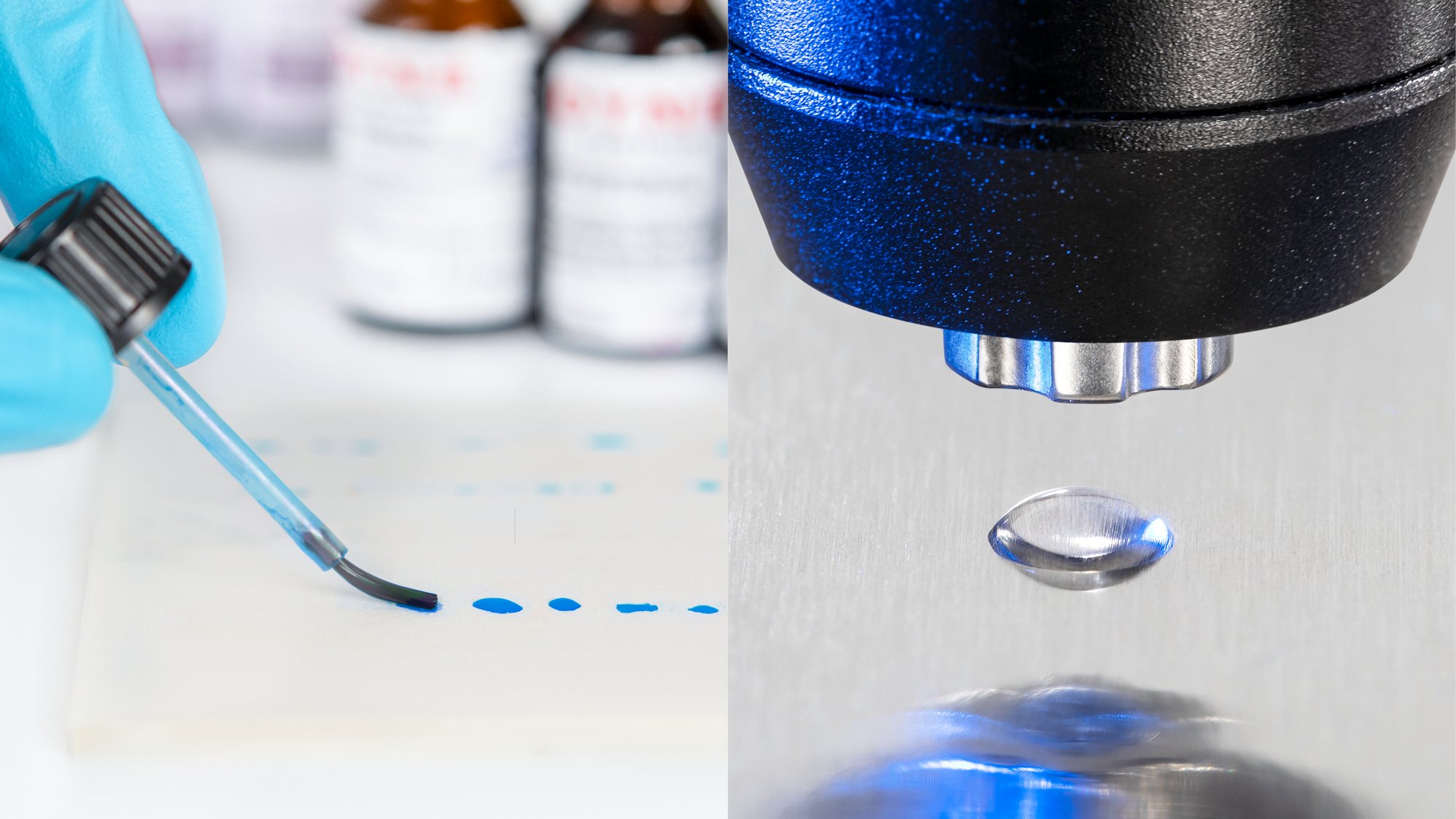
For more than 70 years, dyne pens and test inks have been the industry standard for verifying surface treatment. Developed in the 1950s to support the rapidly growing packaging industry, they provided a simple and effective way to assess surface wettability.
However, anyone who still works with them quickly recognizes the challenges: subjective interpretation, inconsistent results, lack of digital traceability, and toxicity. Until now, though, the introduction of modern measurement methods has also meant new parameters, new specifications, and a costly revalidation of processes.
Digital Dyne® is the solution to this dilemma.

What we are discussing
Dr. Andrew Mellor of KRÜSS will explore how modern surface science is transforming the way we assess surfaces. Discover how quantitative, digital measurement methods can deliver greater objectivity, traceability, and confidence in surface quality control.
Learn how drops of pure water, applied with the Stood-up Drop®, provide Digital Dyne data which strongly correlate with ink tests – ridding you of their drawbacks without the need to redetermine your quality specifications.
What know-how you will gain
-
Why does the dyne test struggle to meet the demands of today's production environments?
-
What is the Digital Dyne and how is it related to the Stood-up Drop technique for measuring the receding contact angle?
-
How can you keep your ink test specification limits when deciding to switch to contact angle for your QC?
Speaker

Dr. Andrew Mellor obtained an engineering doctorate in surface and interfacial physics/chemistry from the London Centre for Nanotechnology (UCL) and currently serves as Team Lead Application Market Manager to our worldwide customer network.
Live Webinar
Register now for this webinar hosted by Dr. Andrew Mellor. Learn about Digital Dyne as a powerful successor to outdated manual ink tests.
➤ Date: Thursday, October 29, 2026
➤ Timeslot 1: 08 am UTC (09 am CET | 04 pm CST) – Best for EMEA & APAC
➤ Timeslot 2: 04 pm UTC (05 pm CET | 12 noon EDT) – Best for EMEA & Americas
The webinar lasts approximately 1 hour.
Can't make the date? Register to receive the recording after the webinar.